How Should You Store and Organize Hiking Gear at Home?
Key Takeaway: Hiking gear fails in storage differently than it fails on the trail — heat cracks leather and breaks down foam, humidity grows mold on packs and boots, and idle batteries corrode the contacts inside headlamps and GPS units. The U.S. Environmental Protection Agency recommends keeping indoor relative humidity between 30% and 50% to prevent the mold and mildew that ruin stored gear, and battery manufacturers including Energizer and Duracell warn that batteries left inside devices for more than 30 days can leak and cause corrosion. Building a hiking gear system around these specific failure points — not just clearing a shelf in the garage — is what keeps boots, packs, and electronics ready to grab instead of ready to replace.
Why Does Hiking Gear Need a Dedicated Storage System?
Hiking gear needs its own storage system because it is damaged more by neglect than by use — heat, humidity, and inactive batteries do more harm over a winter than a full season of trail miles. Unlike car camping bins that sit untouched between trips, hiking gear tends to get grabbed for last-minute trail days, so it has to be both protected and quick to reach. A garage shelf works fine for camping totes, but it is often the worst location for hiking gear specifically, since garages swing through the widest temperature and humidity ranges in most homes.
Three factors cause most of the damage: heat that breaks down foam padding and adhesives, humidity that feeds mold on leather and synthetic fabrics, and batteries left sitting idle in electronics between trips. A storage system built to avoid those three factors will outperform any amount of bin-and-shelf organization on its own — and cataloging your hiking gear up front makes it obvious what needs a dedicated spot versus what can live in a general bin.
How Should You Store Hiking Boots at Home?
Hiking boots should be stored clean, fully dry, and away from direct heat, ideally with a shoe form inside to hold their shape between trips. Boots that go into storage damp or dirty are the single most common source of mold and odor complaints in a gear closet, since trapped moisture and trail dirt do not evaporate the way they would in open air.
Before storage
- Remove insoles and let them air-dry separately overnight
- Brush off dried mud and debris, since trapped dirt holds moisture against leather or fabric
- Wipe boots down and let them dry completely before putting them away — never store boots while they are still damp
During storage
- Use cedar shoe trees or acid-free paper stuffing to hold shape and pull residual moisture
- Store boots upright on an open shelf or boot rack rather than stacked inside a closed bin
- Keep boots several feet from radiators, water heaters, or direct sunlight through a window
Leather-specific care
- Reapply leather conditioner every three to six months during storage, more often in dry climates, per common boot-care guidance from leather boot manufacturers
- Skip sealed plastic bags for leather boots — leather needs airflow, and trapped moisture accelerates mildew growth
What Is the Best Way to Organize a Backpack Storage Area?
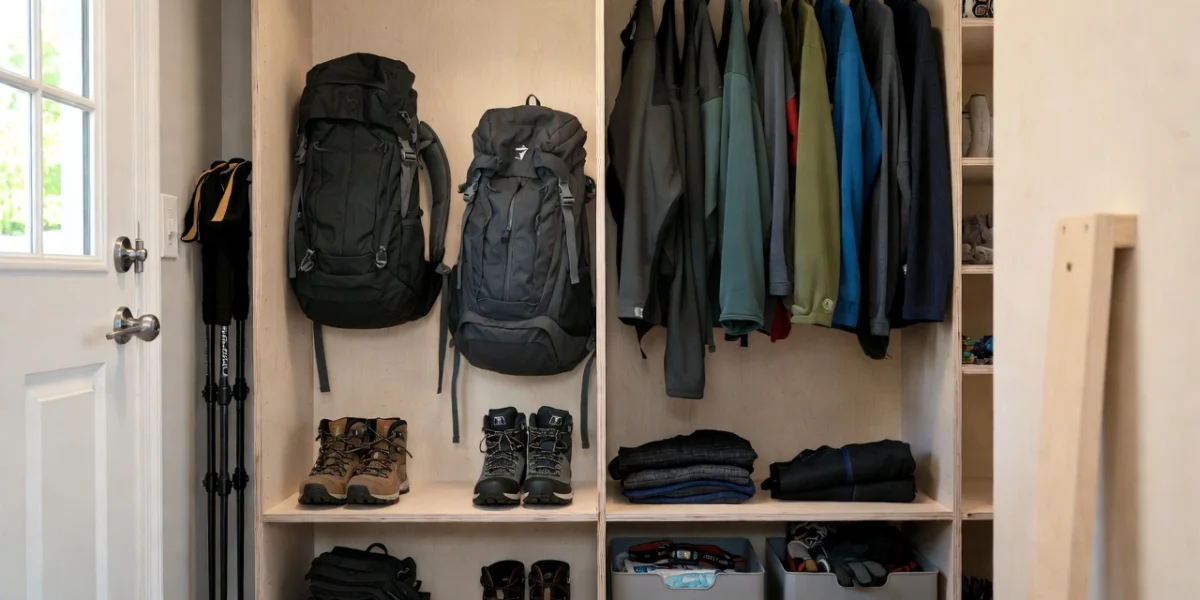
A backpack should be stored loosely packed or fully empty with its frame sheet left in place, never compressed tightly for months at a time, since sustained compression breaks down the foam padding in the hip belt and shoulder straps. Pack manufacturers generally recommend against long-term storage in a stuff sack for exactly this reason — the pack recovers its shape and support far better when it is allowed to sit at rest.
Pack storage basics
- Empty the pack completely after every trip — food residue and damp gear left inside cause odor and mildew fast
- Store on a wall hook or open shelf rather than on a closet floor, where it can pull in moisture
- Leave the frame sheet inserted and the hip belt buckled loosely so the pack holds its intended shape
Multiple packs (day pack, overnight pack, multi-day pack)
- Group packs by size so the right one for a given trip is grabbed in seconds instead of dug out from under a bigger pack
- Tag each pack with its typical loadout — day hike, overnight, multi-day — to speed up repacking
- Clip rain covers and pack liners to their matching pack instead of leaving them loose in a separate bin
How Should You Store Trekking Poles, Layers, and Small Accessories?
Trekking poles, technical layers, and small accessories each have a specific failure mode — dull carbide tips, degraded water-repellent coatings, and a junk drawer full of gear nobody can find — and each is solved with a slightly different storage habit.
Trekking poles
- Collapse fully and store upright in a narrow bin or umbrella stand near the door
- Cap the tips to protect flooring and prevent carbide points from dulling against other gear
- Wipe down the lower sections before collapsing, since trail dust and grit accelerate wear on the locking mechanism
Layers and clothing
- Wash technical layers before storing — body oils and salt residue break down the water-repellent (DWR) coating on rain shells over time
- Fold insulated jackets rather than compressing them long-term, since sustained compression flattens the fill
- Store wool and synthetic base layers separately from cotton so grab-and-go outfits are easy to assemble
Small accessories
- Use a dedicated bin or drawer for compasses, map cases, gaiters, and gloves so nothing gets buried in a junk drawer
- Keep a small repair kit — duct tape, cordage, safety pins — stored with the accessories rather than scattered around the house
How Do You Store Electronics, Batteries, and Navigation Gear Safely?
Electronics and batteries should be stored at room temperature, away from garages and car trunks, with disposable batteries removed from any device that will sit unused for more than 30 days. Battery manufacturers including Energizer and Duracell specifically warn that idle batteries left inside a headlamp or GPS unit can slowly leak and corrode the contacts, which is one of the more preventable ways hiking electronics get ruined between seasons.
Batteries and power
- Remove disposable batteries from headlamps, GPS units, and emergency beacons before storing them longer than 30 days
- Store rechargeable lithium-ion battery packs and power banks at roughly 40-50% charge for long-term storage, not fully charged or fully drained
- Keep electronics in a stable, room-temperature spot — summer heat and winter cold in a garage or car both shorten battery lifespan faster than normal trail use
Navigation and electronics
- Store GPS units, satellite communicators, and headlamps in a padded case or drawer, away from moisture
- Keep paper maps in a dedicated folder or map case so they do not get creased, torn, or lost between trips
- Test electronics and swap batteries a day or two before a trip rather than the night before, so a dead unit does not turn into a last-minute scramble
How Often Should You Audit and Rotate Your Hiking Gear?
A seasonal audit — once at the start of hiking season and once before winter storage — is enough to catch problems before they turn into a bad day on the trail. This is also the point where duplicate and unused gear tends to surface: two similar headlamps, three sets of spare trekking pole tips, a rain shell that has not left the closet in two seasons.
Checking gear twice a year rather than once catches issues a single annual pass misses, since gear that looked fine in spring can develop mold, dead batteries, or worn straps over a full summer of humidity. It is also the easiest time to notice what is simply not getting used, which matters if the goal is a gear closet that reflects how you actually hike rather than everything you have ever bought.
What Are the Most Common Hiking Gear Storage Mistakes?
The most common mistake is defaulting to the garage for hiking-specific gear. The EPA’s 30-50% indoor humidity guideline is difficult to hit in most garages, which routinely swing far outside that range across a full year, making them a poor fit for leather boots, packs, and anything with a battery inside.
The second most common mistake is leaving batteries installed in headlamps, GPS units, and emergency beacons between trips. A device that sat untouched all winter with batteries still inside is one of the most preventable causes of a dead or corroded unit on opening day of the next season.
The third mistake is storing a backpack fully compressed in its own stuff sack for months at a time. The pack technically takes up less space that way, but the padding and frame do not hold their shape as well over a long idle period as they do when left loosely packed or empty on a shelf.
Frequently Asked Questions
How should I store hiking boots between trips? Store them clean and completely dry, upright on an open shelf, with a shoe form or acid-free paper inside to hold their shape. Keep them away from radiators, water heaters, and direct sunlight, and avoid sealed plastic bags, which trap moisture against leather and accelerate mildew.
What humidity level is best for a gear storage closet? The EPA recommends keeping indoor relative humidity between 30% and 50% to prevent mold and mildew. A dedicated gear closet or interior room typically holds that range far more consistently than a garage or basement does.
Should I remove batteries from my headlamp when I’m not using it? Yes, if it will sit unused for more than about 30 days. Battery manufacturers including Energizer and Duracell warn that idle batteries can leak and corrode contacts, which is a common and preventable cause of failed electronics at the start of a new season.
Can I store my backpack fully compressed in a stuff sack long-term? It is not recommended. Sustained compression breaks down the foam padding in the hip belt and shoulder straps over time. Store the pack loosely packed or empty, with the frame sheet in place, for better long-term shape retention.
How often should I condition leather hiking boots? About every three to six months during storage, and more often in dry climates. Regular conditioning keeps leather from drying out and cracking while boots sit unused between trips.
What is the best way to store trekking poles? Collapse them fully, cap the tips, and store them upright in a narrow bin or umbrella stand near the door. Wiping down the lower sections before collapsing helps prevent trail grit from wearing down the locking mechanism.
How often should I go through my hiking gear closet? Twice a year — once at the start of hiking season and once before winter storage — is enough to catch mold, dead batteries, worn straps, and gear duplicates before they become a problem on the trail.
Getting Your Hiking Gear Organized
However your closet or gear room is laid out today, the categories above — boots, packs, poles and layers, and electronics — work as a starting point you can adapt to the space you actually have. Once your gear has a home, ZeroMyGear’s Kit Builder lets you save day-hike, overnight, and multi-day loadouts as reusable lists, so repacking is a checklist instead of a guessing game.
If you are looking for a simple way to keep track of what you already own before you buy a duplicate headlamp or a third set of pole tips, ZeroMyGear offers a free way to catalog your gear collection so everything has a place, and nothing gets bought twice. Start Free and build your first kit today.