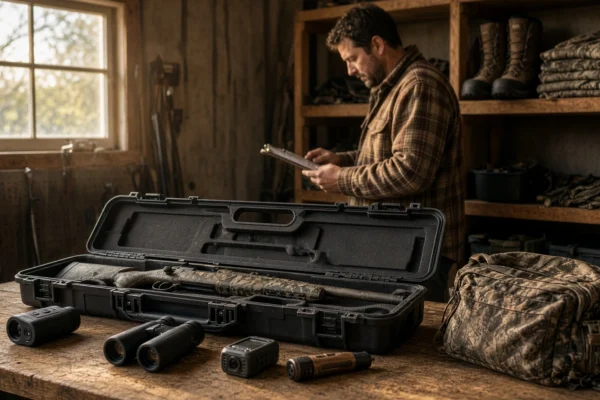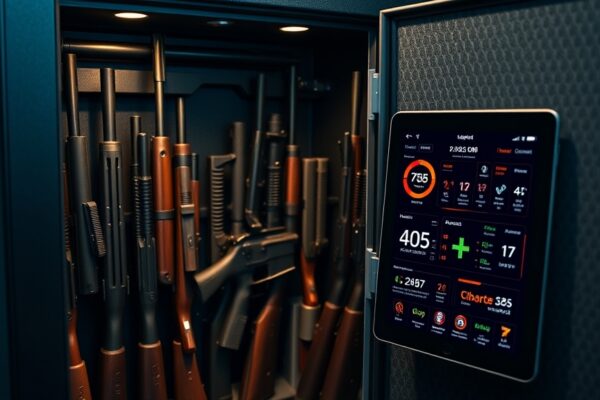
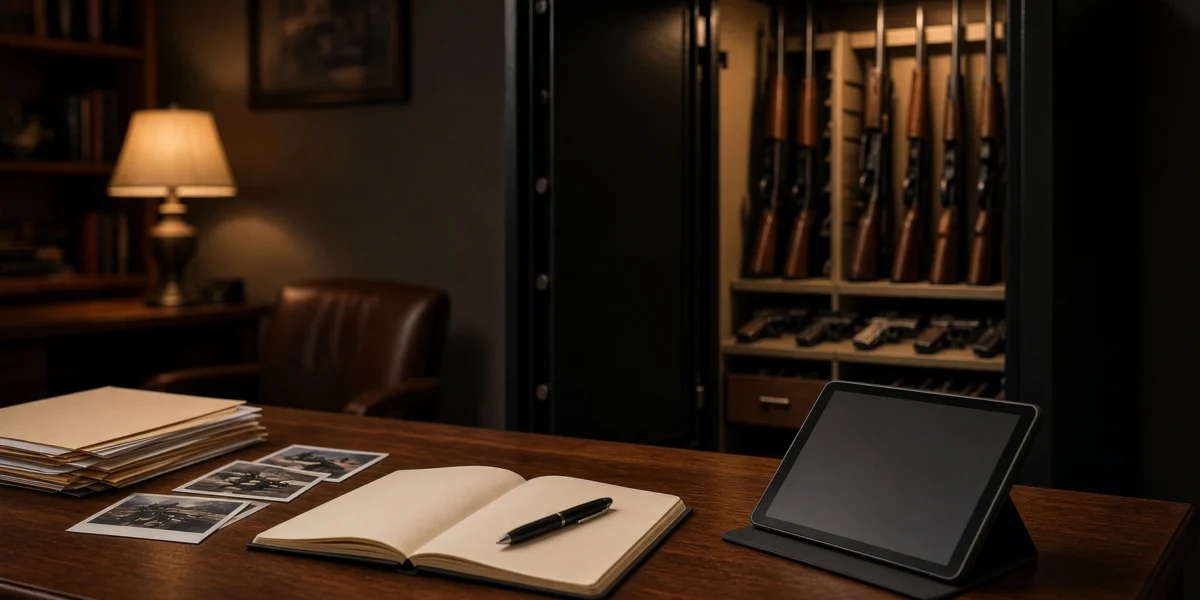
There is a safe in a garage in rural Tennessee — a good one, a Liberty Presidential, bolted to the floor — and inside it are 23 firearms that nobody alive can fully account for. The man who bought most of them passed two years ago. His son is a responsible gun owner himself, not a stranger to the collection, but he cannot tell the insurance adjuster what his father paid for the pre-64 Winchester Model 70, cannot find the bill of sale for the Les Baer 1911, and has no record of whether the Ruger .44 Carbine was transferred legally or handed down before the paperwork era. The estate has been open for eighteen months.
That story is not rare. It plays out in probate courts and insurance offices and estate sales across the country, and the people caught in it are not careless. They were experienced gun owners who trusted their memory, their files, and their knowledge of their own collection — right up until the moment somebody else needed to verify all of it.
A complete firearms inventory is not a bureaucratic exercise. It is the difference between your collection being an asset and being a problem.
Here is how to build one that actually holds up.
Start With What You Actually Have — Not What You Think You Have
Before any app, spreadsheet, or document, the first step is a physical audit. Pull everything. Every firearm in the safe, the cabinet, the lockbox in the truck, the case under the bed that has not moved since the last range trip. Lay them out where you can work systematically and count them.
Most collectors, when they actually do this, find the count is different from the number in their head. Usually higher. Not because of anything sinister — because collections grow in layers over decades, and the human brain is not designed to maintain a running ledger of 30-odd acquisitions spread across 25 years.
Once you have everything visible, resist the urge to rush through documentation. The audit itself — touching each firearm, confirming its condition, noting what belongs with it — is half the value of the exercise. You will find things: a scope that no longer tracks, a magazine that does not seat correctly, a set of rings that fit nothing you currently own.
The Core Record: What Every Entry Needs
A firearms inventory entry that will hold up for insurance purposes, estate planning, or a private sale needs to contain at minimum:
Make, Model, and Configuration
Not just “Remington 700” — note the chambering, barrel length, stock configuration, and any factory options. A Remington 700 CDL in .30-06 with a 24-inch barrel and a walnut stock is a different firearm — and a different value — than a 700 SPS in .308 with a synthetic stock.
Serial Number
Write it down. Photograph it. Cross-reference it against your purchase documentation. The serial number is the only identifier that matters to an insurance company, a probate court, or a law enforcement agency verifying ownership. A description without a serial number is not a record — it is a memory.
Action Type and Caliber
Bolt, semi-auto, lever, pump, single-shot, revolver, semi-auto pistol. Then the chambering, precisely: .30-06 Springfield, not “30-ought-six.” 9mm Luger, not “nine mil.” Precision in documentation avoids ambiguity downstream.
Condition
Use a recognized standard — the NRA grading scale (Perfect, Excellent, Very Good, Good, Fair, Poor) is widely understood and what most valuation references use. Your own description (“barely used”) is not useful to an appraiser.
Purchase Information
Date of purchase, source (dealer name and FFL number if applicable, private party, estate sale, auction house), and price paid. If you have the receipt, scan it. If you have the Form 4473 copy, include a reference to it. Price paid matters enormously when you sell or when an estate is being appraised — without it, you cannot establish cost basis or demonstrate what the collection represents as an investment.
Acquisition Documentation
For transfers that went through an FFL, note the transfer date and keep a copy of the receipt. For private sales in states where they are legal, note the date, the seller’s name if you have it, and any bill of sale. This is not about compliance theater — it is about being able to demonstrate a clean chain of ownership if you ever need to.
Photography: Do It Right or Do It Again
A written description without photographs is an incomplete record. A photograph without a written description is a mystery. You need both.
For each firearm, take a minimum of four photographs:
Right Side, Full Profile
Firearm unloaded, action open where applicable, laid on a clean neutral surface. Natural light if possible — it renders finish and wood grain more accurately than shop lighting.
Left Side, Full Profile
Same conditions.
Serial Number, Close-Up
Sharp focus on the number. If the number is stamped in a low-contrast location, use raking light from the side to improve legibility.
Any Distinguishing Features
Custom work, damage, repairs, engravings, non-original components, unusual markings. Document anything that affects value or identification.
Store these photographs somewhere that is not your phone’s camera roll. A cloud-based folder organized by firearm, a dedicated photo archive, or an inventory app that ties images directly to a catalog record. The goal is that someone else — an executor, an insurer, an heir — can open your records and immediately connect the photograph to the written entry without guesswork.
Valuation: What Your Collection Is Actually Worth
This is the part people underestimate most, in both directions.
Some collectors believe their collection is worth considerably more than it is, because they remember what they paid and have not tracked what the market has done since. Others — particularly those who bought used, bought at auction, or inherited pieces — have no idea they are holding firearms that have appreciated significantly.
There is no single source of truth for firearms valuation, but the most widely accepted references are:
- Blue Book of Gun Values — updated annually, covers production firearms extensively
- Standard Catalog of Firearms — better for collectibles and variants
- GunBroker completed sales — the best real-market data for what similar firearms are actually selling for, as opposed to what sellers are asking
- Rock Island Auction realized prices — essential for collectible and high-value firearms
For a working inventory, document both your purchase price and a current estimated value with a valuation date. Update the estimated value every few years, or when you have reason to believe the market has moved significantly. A pre-64 Winchester, a Colt Python, or a Springfield Armory M1A is not worth what it was worth five years ago.
If your collection’s estimated value is significant, consider a professional appraisal from a certified firearms appraiser — particularly if you carry a personal articles policy or a scheduled firearms endorsement on your homeowner’s policy. Insurance companies pay replacement cost or appraised value, not what you believe the collection is worth.
Maintenance History: The Record Nobody Keeps
Most gun owners have some version of a maintenance routine. Almost none of them document it.
This matters more than it sounds. A documented maintenance history:
- Tells a buyer that the firearm has been cared for, not just stored
- Identifies patterns (a particular action that needs cleaning every 500 rounds, a recoil pad that was replaced because the original cracked)
- Creates accountability if a firearm is ever sent to a gunsmith — you have a record of what was done and when
- Preserves the value of the record for estate purposes — a vintage rifle with documented care history is more credible to a serious buyer than one with no paper trail
For each firearm, track: date of last cleaning, rounds fired since last service where relevant, any gunsmith work with the smith’s name and description of the work, and any part replacements. This does not need to be elaborate — a few lines per entry per year is sufficient for most firearms.
Accessories, Optics, and What Goes With What
A complete inventory accounts for what belongs to each firearm, not just the firearm itself.
A Leupold VX-5HD sitting in your scope drawer is worth several hundred dollars and belongs on a specific rifle. If your inventory does not note that the scope is mounted on the .300 Win Mag, or that it came with that rifle as a package, or that you purchased it separately three years after the rifle — then you have a scope and a rifle that appear to be unrelated assets.
Document optics, mounts, rings, slings, custom grips, trigger upgrades, and any aftermarket work as line items associated with the relevant firearm. Note purchase date, price paid, and current configuration. If the scope lives on the rifle, say so. If it is a dedicated hunting scope you swap seasonally, note which rifle it is zeroed for.
This also applies to ammunition — not necessarily every round, but lot numbers and quantities for calibers where you have invested in volume purchasing. A significant ammo cache is a real asset and belongs in a complete inventory.
Where to Keep It and Who Needs to Know About It
A firearms inventory that exists only on your phone or in a folder you have never told anyone about does not serve its primary purpose. The point of the record is that it is accessible when it needs to be — which means accessible to someone other than you, in conditions where you may not be present.
A few practical considerations:
Secure, Not Secret
Your inventory should be accessible to the people who would need it — a spouse, an executor, an attorney handling your estate — without being broadly accessible. A password-protected cloud folder with access shared appropriately is more useful than a locked file nobody can open.
Tell Your Executor It Exists
Specifically, tell them where it is and how to access it. Include the location of any physical documentation (bills of sale, transfer receipts, appraisals) that supports the digital record.
Keep a Physical Backup
A printed summary — not necessarily every photograph, but a list of makes, models, serial numbers, and estimated values — stored with your estate documents is a practical redundancy.
Update It
A firearms inventory that was accurate three years ago and has not been touched since is a starting point, not a record. When you acquire a firearm, add it before you put it in the safe. When you sell one, mark it disposed with the date and buyer information. Ten minutes of discipline at the point of transaction saves hours of reconstruction later.
The Reason to Do This Now, Not Later
Estate attorneys and insurance adjusters see the same pattern repeatedly: the gun owner who managed a significant collection for 40 years without a written record, and the family that inherits the aftermath. The collection itself is often fine. The documentation is not, and that gap — between what the collection is worth and what can be proven — costs heirs real money and real time.
The other scenario nobody likes to think about: a burglary, a fire, a flood. An insurance claim for firearms without documentation is nearly impossible to settle accurately. You are negotiating against your memory, and the insurer knows it.
None of this requires being morbid about it. It requires being practical — the same kind of practical that led you to buy the safe, maintain the rifles, and keep your transfers clean. The inventory is just the next logical step in managing what you have built.
If you have been managing your collection in a spreadsheet, or in your head, or in a folder of photos with no attached data — you already know the system is not scaling. ZeroMyGear was built to handle exactly this: catalog your collection with photos and specs, track maintenance history, document purchase information, and keep everything in one place that is yours and stays yours. It is not a replacement for good habits. It is what good habits look like when your collection outgrows the spreadsheet.
Start with the safe audit. Pull everything out. Count it. The rest follows from there.